

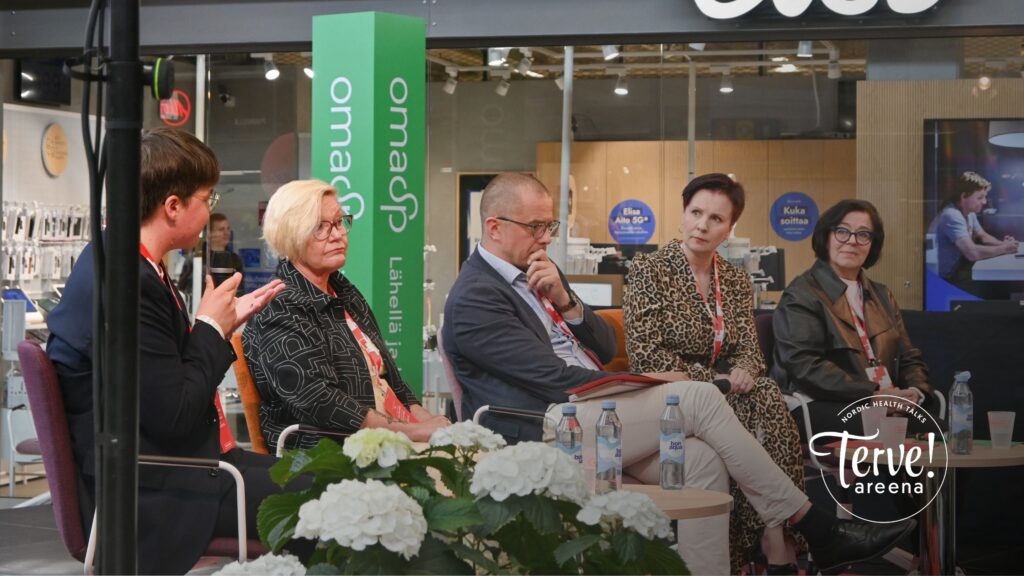
Rare diseases affect up to 450,000 Finns, but care is not equal for everyone. At the Terve!Areena panel discussion at SuomiAreena in Pori on Wednesday, June 24, 2026, the question was posed: what is needed to ensure that people with rare diseases receive timely, equal, and competent care regardless of where they live?
Participants in the discussion included National Coalition Party MP Ville Väyrynen, Chief Nephrologist Satu Mäkelä from the Wellbeing Services County of Pirkanmaa, Wellbeing Services County Director Sally Leskinen from the Wellbeing Services County of South Karelia, Specialist and Renal Care Nurse Maarit Heinimäki from the Kidney and Liver Association, and Chair of the Vasculitis Association and Expert by Experience Runo Nopanen. The discussion was moderated by Eva Torra from Ahjo Communications.
Care pathways for rare diseases need clarity
The discussion highlighted that the journey to a diagnosis for someone with a rare disease can be long and care fragmented. Once a patient accesses the right expertise and treatment, the care can be good, but the challenge is often finding the correct care pathway and ensuring continuity of care. Patients may have to navigate between different healthcare providers without a clear overview of who is responsible for their care and what happens next. Panelists emphasized that much can be done right now. What is needed are clear procedures, better information flow between healthcare providers, effective consultation channels, and stronger care coordination. One concrete solution would be to strengthen patient-specific care plans for rare diseases as well. When treatment goals, responsible parties, and next steps are clearly documented, patients do not have to carry the burden of coordinating their entire care pathway themselves.
The growing role of primary healthcare and patient organizations
The panel also highlighted the role of primary healthcare. Specialized healthcare is a key component of rare disease treatment, but as appointments become shorter and the need for continuity of care grows, primary healthcare also requires more expertise, information, and clear consultation channels. At the same time, the importance of patient organizations has grown. When the healthcare system does not always have enough time to support adjustment to an illness, organizations offer peer support, information, and practical understanding of what living with a disease means in daily life. Patient organizations also play a vital role in bringing patient voices to decision-making and the development of care pathways. They possess experiential knowledge that cannot be found elsewhere in the system in the same way.
Trust grows from continuity
A rare disease patient’s trust in care is built on practical matters: whether the person is heard, whether information is passed along, whether expertise is available, and whether the patient knows who to contact.
The message of the Terve!Areena discussion was clear: individuals with rare diseases must not be left alone. Care can be improved right now by clarifying responsibilities, enhancing communication, and ensuring that patients have care plans tailored to their situation.
Event organizers and background:
The event at SuomiAreena was organized by CSL, the Kidney and Liver Association, the Vasculitis Association, and Ahjo Communications as part of Terve!Areena, which focuses on current issues in welfare policy. Terve!Areena brings together health sector experts, decision-makers, organizations, and companies to find solutions to the challenges facing Finnish healthcare. You can learn more about Terve!Areena and previous panel discussions on our website.
Follow Terve!Areena on social media:
- LinkedIn: Terve!Areena
- Facebook: terveareena
- Instagram: @terveareena